What's Living Under Your Feet: The Surprising Truth About Basements, Crawlspaces, and Your Family's Health
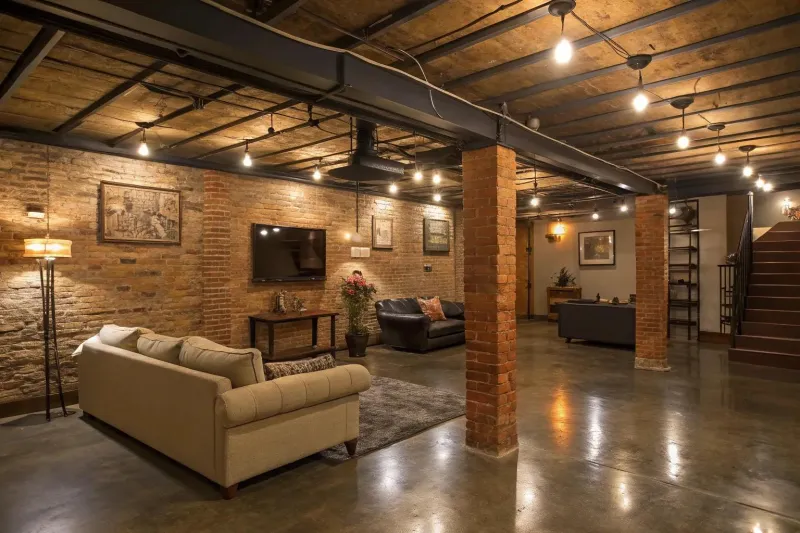
Photo: basement crawlspace moisture encapsulation vapor barrier healthy home, via lightandlayer.com
Most of us treat the basement or crawlspace like a storage unit we'd rather not think about. Out of sight, out of mind — until the musty smell creeps upstairs, the utility bills spike, or someone in the family starts dealing with persistent sneezing and brain fog that nobody can quite explain.
Here's the thing: that below-grade space isn't separate from your home. It's foundational to it — literally and figuratively. The air quality, moisture levels, and biological activity happening beneath your feet have a direct, measurable impact on everything above. And in most American homes, it's being completely neglected.
Let's change that.
Why Below-Grade Spaces Are Different (and Harder to Manage)
Basements and crawlspaces operate under a fundamentally different set of physical conditions than the rest of your home. They're surrounded by soil, which is perpetually damp. They often have limited airflow. They sit at the bottom of your home's thermal stack, meaning they're typically cooler than the living spaces above — and cooler surfaces attract condensation like a magnet.
That combination — moisture, limited ventilation, and cool temperatures — is basically a welcome mat for mold, mildew, dust mites, and a whole cast of biological characters you really don't want sharing your air.
And here's the kicker: air doesn't stay put. Thanks to something called the stack effect, warm air in your home naturally rises and escapes through the upper levels, pulling air upward from below. That means whatever is hanging out in your crawlspace — mold spores, radon, volatile compounds from old insulation or stored chemicals — gets drafted right into your living spaces. Studies suggest that in many homes, up to 50% of the air on the first floor originated in the basement or crawlspace. That's not a small detail.
The Moisture Problem (and Why It's Almost Always There)
If you've never had a moisture problem in your basement, you're in the minority. Groundwater seepage, condensation from warm humid air hitting cool concrete walls, and poor drainage around your foundation are all incredibly common — especially in older homes, and especially in regions like the Southeast, Midwest, and Mid-Atlantic where humidity and rainfall are significant.
Signs of moisture trouble include:
- White chalky deposits (efflorescence) on concrete walls
- Rust stains near wall penetrations
- Paint that's peeling or bubbling
- A persistent earthy or musty smell
- Visible mold or dark staining
- Wood framing that feels soft or spongy
Even if you don't see obvious mold, elevated moisture levels create the conditions for it to grow. Mold can colonize in as little as 24–48 hours on wet organic material — and there's plenty of that in most basements, from wood framing to cardboard boxes to old drywall.
Mold Isn't Just Ugly — It's a Health Issue
This isn't about being overly precious. The health effects of chronic mold exposure are well-documented and genuinely serious. Mycotoxins produced by certain mold species (Stachybotrys, commonly called black mold, being the most notorious) can trigger respiratory issues, fatigue, cognitive symptoms, and immune dysfunction. Even less aggressive mold species contribute to worsening asthma, allergies, and sinus problems.
Kids and elderly family members are especially vulnerable. And because symptoms often develop gradually and mimic other conditions, mold-related illness frequently goes undiagnosed for months or years.
If anyone in your home has been struggling with unexplained chronic symptoms — especially respiratory or neurological ones — your below-grade spaces deserve serious attention.
The Radon Reality Check
Moisture and mold get most of the press, but radon is arguably the more urgent threat in many parts of the country. This colorless, odorless radioactive gas forms naturally from uranium decay in soil and rock, and it seeps into homes through foundation cracks, gaps, and sump pits.
Radon is the second leading cause of lung cancer in the US, responsible for roughly 21,000 deaths annually according to the EPA. The good news: it's entirely testable and treatable. Short-term radon test kits are available at most hardware stores for under $30, and a professional mitigation system — typically a sub-slab depressurization setup — runs between $800 and $2,500 for most homes.
If you haven't tested, test. Full stop.
Crawlspace vs. Basement: Different Animals
Crawlspaces present their own particular challenges. Many older homes have vented crawlspaces — a design approach that was once thought to be the right call but has largely been debunked. Venting a crawlspace in a humid climate actually introduces warm, moisture-laden outdoor air into a cool underground space, which accelerates condensation and mold growth rather than preventing it.
The current best practice in most US climates is encapsulation: sealing the crawlspace with a heavy-duty vapor barrier (typically 20-mil polyethylene), insulating the walls rather than the floor above, and conditioning the space either with a dehumidifier or by connecting it to your home's HVAC system. This transforms the crawlspace from a liability into a semi-conditioned buffer zone that actually helps your home's energy performance.
For basements, the strategy depends heavily on whether moisture is entering from outside (a waterproofing issue) or condensing from interior air (a humidity control issue). Both are solvable, but they require different approaches.
Practical Steps You Can Take Right Now
You don't have to tackle everything at once. Here's a reasonable progression:
1. Assess before you act. Walk through your basement or crawlspace with fresh eyes. Use a basic hygrometer (under $20 on Amazon) to check relative humidity — anything consistently above 60% is a problem zone. Look for visible moisture, staining, or soft wood.
2. Test for radon. It's cheap, fast, and potentially life-saving.
3. Fix the water source. If water is actively entering your basement, no amount of dehumidifying will solve it. Grading issues around your foundation, clogged gutters, and missing downspout extensions are often the culprits — and fixing them is usually the most affordable first step.
4. Control humidity. A properly sized dehumidifier can keep basement humidity in a safe range. Look for Energy Star-rated models to keep operating costs manageable.
5. Consider encapsulation for crawlspaces. This is a bigger investment — typically $3,000–$8,000 depending on size and conditions — but it pays dividends in air quality, energy efficiency, and home value.
6. Address any mold you find. Small areas (under 10 square feet) can often be handled DIY with proper protective equipment and an EPA-registered fungicide. Larger infestations warrant a professional remediation company.
Turning a Liability Into an Asset
Here's the reframe that makes all of this worth doing: a healthy, properly managed below-grade space isn't just the absence of a problem. It's a genuine contributor to your home's performance and your family's wellbeing.
A sealed, conditioned crawlspace improves your heating and cooling efficiency — sometimes dramatically. A dry, well-maintained basement becomes usable square footage. And a home with documented, addressed moisture and radon concerns is a more valuable, more marketable property when the time comes to sell.
At Two Healthy Homes, we talk a lot about spaces that nourish you and the planet. That vision doesn't stop at the living room floor. It goes all the way down — and what you find there, and what you do about it, shapes everything above.